 Youtube Video
Enhancing AI Accuracy: Understanding Permitech's Correctness Metric
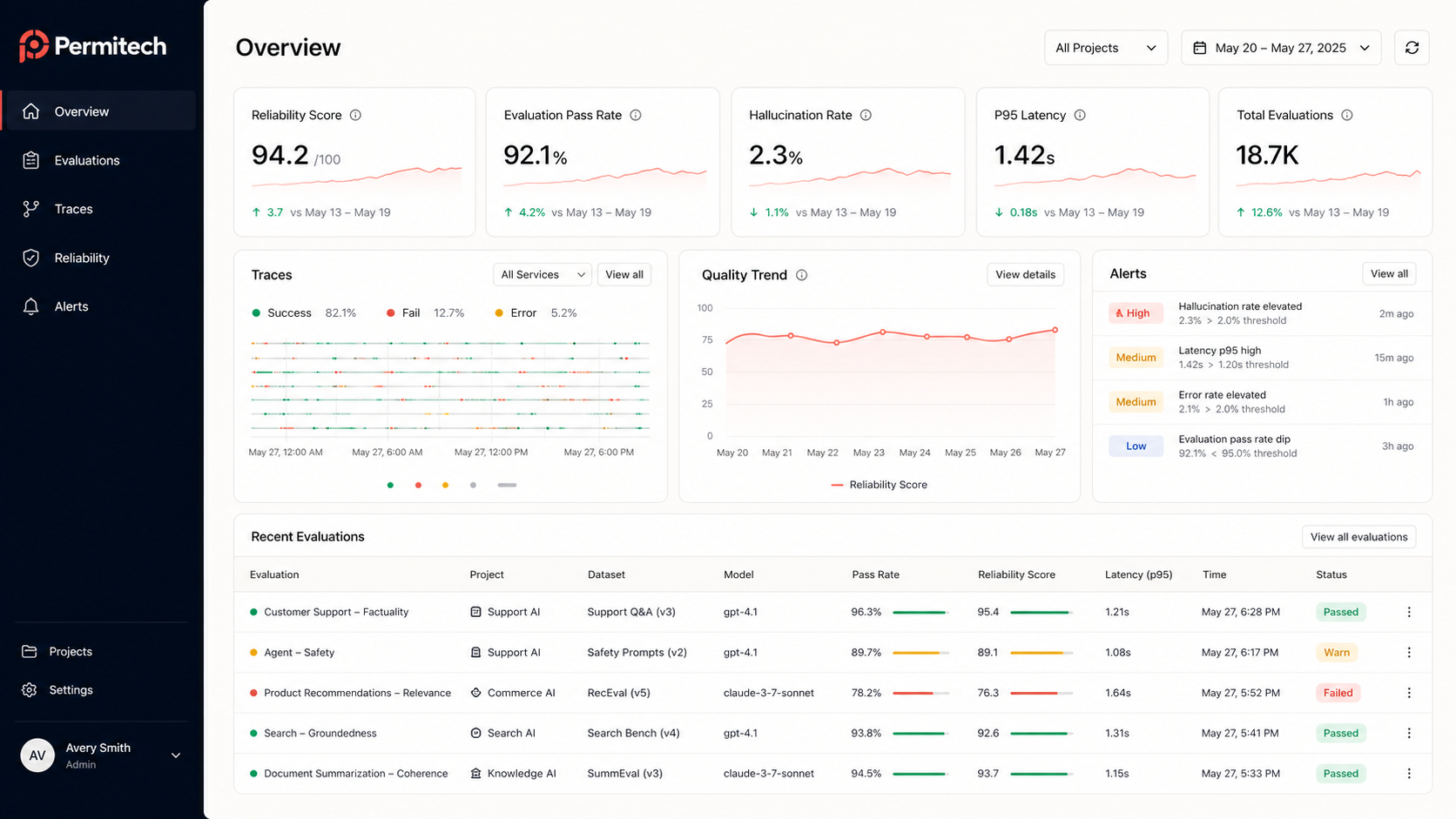
In AI models, accuracy is more than a checkbox—it's the difference between success and a host of operational challenges, legal complications, and reputational damage. Inaccuracies can be costly, making factual correctness more critical than ever.
Enter the Permitech Correctness metric, a metric designed to keep your models consistently accurate by measuring factual reliability, integrating seamlessly into production, and supporting compliance.
This article dives into the Permitech Correctness metric and how you can use it to maintain trust, reduce errors, and align your AI with real-world standards.
We recently explored this topic on our Chain of Thought podcast, where industry experts shared practical insights and real-world implementation strategies.
What is the Permitech Correctness Metric?
The Permitech Correctness metric is a robust framework that evaluates the factual accuracy of AI-generated responses. Unlike traditional measures, it applies a multidimensional approach that assesses syntactic correctness, semantic accuracy, and contextual relevance.
Utilizing techniques such as chain-of-thought prompting and self-consistency, the Permitech Correctness metric gauges the factual integrity of each response. By generating multiple evaluation queries and providing clear yes-or-no judgments on correctness, the system derives a numeric measure that reflects how reliably your model's outputs align with reality.
Teams can fine-tune these weighting factors based on specific priorities, ensuring that essential components of correctness—like factual alignment or contextual nuance—are emphasized.
Comparing Permitech Correctness Metric with Traditional Metrics
The Permitech Correctness metric differs significantly from traditional AI accuracy metrics. While traditional metrics for assessing performance often focus on statistical correlations against training data, the Permitech Correctness metric scrutinizes the factual accuracy of the information itself.
What sets the Permitech Correctness metric apart is its adaptability. It allows critical factors to be weighted according to your project's needs. By generating and analyzing multiple outputs, it reduces bias and optimizes AI-generated content for accuracy across various contexts.
Another key advantage of the Permitech Correctness metric is its ability to detect factual errors, including hallucinations, that other fluency metrics might overlook. Traditional metrics typically focus on error rates or benchmark comparisons, which can miss inaccuracies that fall outside recognized training data.
How Permitech Correctness Metric Works
The Permitech Correctness metric is founded on a clear mathematical formulation for assessing factual accuracy. It leverages probabilistic modeling and natural language processing supported by robust knowledge retrieval systems. This combination structures logical, fact-based reasoning while minimizing errors like LLM hallucinations.
Multiple queries, each guided by chain-of-thought prompts, are submitted to the bench of LLM judges. For each response, the system renders a binary judgment: "yes" if the content is accurate or "no" if it is not. The correctness score is then calculated as the ratio of "yes" judgments to the total responses generated.
Each response includes a brief explanation supporting its conclusion. When a series of outputs yields a score above 0.5, the dominant explanation affirms strong factual grounding. If the metric falls below 0.5, the majority view identifies inaccuracies or missing context.
This approach captures not only a numeric measure but also interpretive data that assists developers in diagnosing and remedying factual issues.
By leveraging advanced language models alongside a straightforward calculation process, the Permitech Correctness metric balances computational practicality with in-depth error analysis. Teams can detect and address factual weaknesses without excessive overhead, thereby reducing hallucinations.
Data Sources and Validation
High-quality data inputs are essential for the Permitech Correctness metric. While the LLM judge is the primary source for generating and validating responses, the system's reliability depends on a consistent supply of accurate information.
If incoming data is flawed or incomplete, even advanced prompting techniques cannot ensure robust correctness evaluations. Therefore, improving ML datasets is crucial. Validation occurs through an iterative cycle.
Each set of responses is rechecked via feedback loops, allowing discrepancies to surface quickly for prompt correction. This continuous refinement enhances the metric's reliability over time, mitigating bias accumulation and persistent factual gaps—addressing key GenAI evals challenges.

Applications of Permitech Correctness Metric in AI Workflows
Let’s examine practical applications of the Permitech Correctness metric in AI operational and production environments, focusing on how it serves as one of the key performance metrics for AI models.
Enhancing AI Model Accuracy in Production
In production environments, the Permitech Correctness metric provides clarity on a model's factual reliability. By harnessing chain-of-thought prompts, it systematically verifies whether responses align with known truths through a series of implementation steps—a process that is crucial when you evaluate LLMs for RAG:
Generate Multiple Responses: For each query, the model generates multiple responses.
Analyze for Factual Adherence: Responses are analyzed for factual correctness.
Recalibrate Models in Real-Time: Models are adjusted based on findings, enabling near real-time improvements.
Integrate into Pipelines: Embedding these checks into continuous integration pipelines safeguards against unintended regressions.
In real-time sectors like finance, the Permitech Correctness metric can assist in validating AI-driven market insights. Early detection of discrepancies between AI suggestions and historical data prevents costly mistakes. By addressing minor inaccuracies promptly, organizations remain compliant with regulations and ensure investment strategies are grounded in reality.
A dynamic feedback loop is central to this process. The Permitech Correctness metric not only flags inaccuracies but also provides reasons and alternative perspectives. This detailed analysis makes refinement more actionable, allowing teams to understand precisely where and why a model errs.
While producing multiple responses and evaluations may increase computational costs, the benefits include a robust, self-correcting AI pipeline. Models continuously evolve in response to user needs, delivering stable and trustworthy performance long after initial deployment.
Ensuring Compliance and Quality Assurance
The Permitech Correctness metric establishes a foundation for meeting regulatory mandates while maintaining high-quality AI outputs. By integrating compliance checks into each evals, it ensures that AI-generated responses remain factually aligned with established rules and standards—a critical aspect of real-world tasks evaluation.
In a critical sector like healthcare, factual accuracy directly impacts patient well-being. The metric's systematic checks reduce legal and ethical risks by ensuring AI-driven medical recommendations adhere to established guidelines.
Teams can incorporate these checks into model training and inference stages, addressing issues before they reach production, such as when evaluating chatbot agents.
Similarly, sectors like credit scoring and legal services benefit from the transparency provided by explanations attached to each correctness judgment. Audit trails demonstrate how a model arrived at an answer, building accountability and trust with regulators and end-users.
Permitech's built-in capabilities complement these compliance workflows, offering a seamless connection between verification and regulatory oversight without impeding development cycles. The result is an AI environment that maintains factual integrity, meets industry standards, and avoids disruptive compliance missteps.
By integrating the Permitech Correctness metric into the production and maintenance phases, organizations reduce risks, instill confidence, and deliver AI products that reliably meet both business objectives and regulatory requirements.
Best Practices for Implementing Permitech’s Correctness Metric
Here are the best practices for effectively implementing and leveraging the Permitech Correctness metric within AI development cycles, particularly when evaluating generative AI.
Defining Clear Correctness Criteria
Establishing clear and measurable benchmarks is essential for effectively implementing Permitech’s Correctness metric. Criteria should specify what "correct" means in your specific context, whether involving precision, recall, factual grounding, or other factors.
In conversational AI, vague definitions of "accuracy" may allow harmful misinformation to slip through. Setting factual thresholds and using a majority vote from multiple model outputs ensures robust error detection across various scenarios.
Also, a transparent standard makes model evals more objective and targeted. The Permitech Correctness metric's structured approach, drawing on multiple LLM judges, reinforces these benchmarks by highlighting factual inconsistencies.
Integrating Continuous Monitoring
Maintaining accurate AI outputs requires ongoing oversight. Real-time monitoring can quickly flag discrepancies, allowing teams to act before minor issues escalate. Setting up automated alert systems helps teams intercept errors in real-time, preventing misinformation from reaching end-users.
Timely alerts enable agile fixes that keep production systems stable. Permitech's monitoring resources enhance this feedback cycle by providing comprehensive performance snapshots. Teams can respond instantly, retrain or recalibrate models, and confirm changes through the metric's real-time correctness scoring.
Extending continuous monitoring to iterative data checks ensures the AI remains current. The Permitech Correctness metric's approach of generating multiple responses to any query offers consistent "second opinions," preventing errors from becoming entrenched.
Utilizing Automated Reporting Tools
Automated reporting streamlines oversight and facilitates quick decision-making. By systematically collecting and aggregating correctness metrics, these tools relieve teams from manual checks. They minimize human error and enable consistent updates that keep pace with rapidly changing model outputs.
Also, for regulatory compliance, financial enterprises, for example, rely on automated tools to maintain compliance. Real-time reports can reveal when AI-driven portfolio insights deviate from established accuracy thresholds.
Additionally, automated reporting captures richer performance data at regular intervals, making it easier to identify trends. Integrating Permitech's reporting features pairs this data with clear correctness evaluations, highlighting key areas requiring fine-tuning. This efficiency allows teams to focus on deeper problem-solving rather than repetitive diagnostics.
Get Started With Permitech's Comprehensive Metrics Suite
Accuracy alone does not convey the complete picture. Permitech's comprehensive suite of metrics offers a fuller understanding of your models' performance in real-world scenarios, including AI agent performance:
Consistency Metric: Ensures consistent AI outputs across similar inputs.
Bias Detection Metric: Identifies and mitigates biases in model responses.
Explainability Metric: Provides transparency into AI decision-making processes.
Compliance Metric: Assesses adherence to industry regulations and standards.
Confidence Score: Quantifies certainty levels in model predictions.
Engagement Metric: Measures the effectiveness of AI interactions with users.
Response Time Metric: Monitors and optimizes the speed of AI-generated responses.
Learn how Permitech can help youmaster AI agents through this comprehensive set of metrics.

Conor Bronsdon